

The story of the E-ball valve
In connection with a valve course held in 1989, I was challenged by an engineer to design a ball valve solution that was more resistant to opening with differential pressure and more sealingly reliable than the conventional trunnion ball valve. Challenges with soft-sealing trunnion ball valves are opening with differential pressure and impurities in the medium. Opening with differential pressure can cause the seat seal to break quickly, and impurities in the media can prevent the necessary movement of the seats in the seat pocket. Both of these situations can result in internal valve leakage.
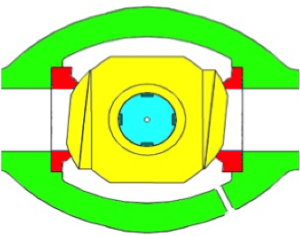
Fig. 1
After a few weeks of thinking, the solution was a design where the ball and seats have sealing surfaces at approximately an 85-degree angle to the pipe as illustrated in Figure 1 - an eccentric ball valve. With this solution, it was possible to lock the seats so that they did not need to float in the seat pocket. Another advantage of the design is that there will be a large flow area around the entire sealing path of the ball at the moment the sealing surface of the ball releases the seats. This reduces wear on the sealing surfaces, which is a major problem on traditional ball valves when they are opened with a differential pressure. Because the sealing faces in my design are at about an 85-degree angle to the pipe, the valve will have a mechanical seal on both seats.
The first patent was granted in Norway in 1990, and thus began the struggle to find interested parties so that the valve could be manufactured. Because the design of the valve was extremely complicated to manufacture, it would be a very expensive valve and probably the most expensive ball valve solution on the market.
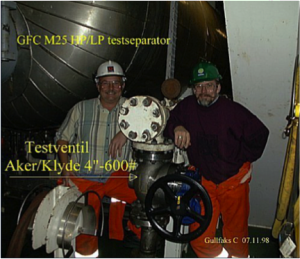
Fig. 2
It was five years before Aker Maritime at Stord saw the potential of the valve. So in 1995, Aker Maritime and I signed an agreement on the development and commercialization of the valve; it was named the Aker/Klyde valve. Gullfaks C was willing to test the valve on the sand outlet under the HP/LP test separator where they had significant valve problems. Figure 2 shows Roy Hansen and myself next to the first Aker/Klyde valve installed on the Norwegian continental shelf on November 7, 1998.
After approximately 250 operations, a small leak occurred past the inlet seat and into the valve body, but the valve was still tight on the outlet seat. The adjustable end stop was adjusted out a quarter turn after which the valve again sealed on the inlet seat.
Although the valve functioned satisfactorily, it was dismantled for inspection in May 1999. Upon inspection, the valve showed some wear on the inlet seats, which contributed to a small leak into the valve body. The valve was reinstalled and stood for a further two years before being replaced with a similar valve. The test on Gullfaks C simulated 4-5 years of service life on an application where normal service life was 6-12 months.
The test was so successful that Statoil placed an order for a number of valves to be installed in the produced water systems. The first delivery was in March 2000.
From April 2000 to November 2002, 73 valves from 3" - 6" in classes 600 - 1500 were delivered. The installations that received Aker/Klyde valves were: Åsgard A, Gullfaks A, B and C, Oseberg, Sleipner, Snorre, Statfjord C and Kårstø gas plant.
A number of tests were carried out on the valve. These included a surgical test where, after 500 operations, there was a leakage rate of 20 drops per minute at 100 bar differential pressure and, after 1,000 operations, 35 ml per minute at 100 bar differential pressure.
In 2001, a sand slurry test was carried out to verify that the construction could withstand what was expected. A 4" class 600 valve was manufactured and fitted into a 4" test loop illustrated in Figure 3. Figure 4 shows the valve when fitted into the test loop.
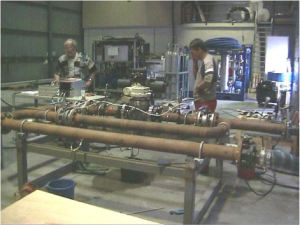
Fig. 3
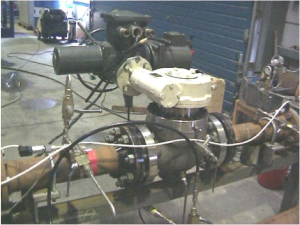
Fig. 4
The test loop was connected to a water tank with a volume of 6,000 liters, which was filled with 3,000 liters of water and added 30 kg of fine-grained sand. The pump used had a pump height of 65 meters (approximately 6.5 bar) and at full capacity gave a flow rate of 5.5 meters per second.
The valve was to be opened with a differential pressure of 100 bar, which was applied to the inlet side of the valve after every 10th operation. Normal operation was opening with the differential pressure provided by the pump and closing where the sand slurry had a speed of 5.5 meters per second. The operation time of the valve was set to 15 seconds from fully open to fully closed and the same in the opposite direction.
The test documented what we expected. After 1,000 operations, the water test at 100 bar differential pressure showed a leakage rate on the inlet seat of 115 ml per minute and the outlet seat had a leakage rate of 35 ml per minute.
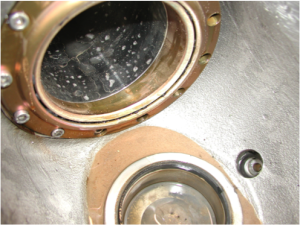
Fig. 5
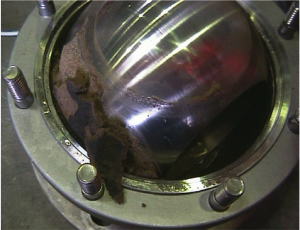
Fig. 6
When the Aker/Klyde valve was dismantled, it turned out that there was very little sand inside the valve body, as illustrated in Figure 5. Because there was a flow inside the valve body on the outside of the ball, the impurities in the valve body were washed out by the flow. In contrast to the Aker/Klyde valve, the conventional ball valves were full of sand inside the valve body (see figure 6). There was approximately 200 gr. of sand inside each of the respective 4" service valves, which made them very difficult to operate. It also turned out that the pump's impellers and seals were damaged after the sand slurry test.
After the sand slurry test, additional valves were ordered. Now, however, problems arose with the valves; after final machining and assembly, large high-pressure valves had problems with the tests. Seat design and machining of the valve parts proved problematic. Because of the problems, it was decided in 2001 that Aker Maritime would collaborate with Bel Valves in the further development and production of the valve. The valve's name was now changed to the AkerBel valve.
One of the problems with the valve was the seal, which turned out not to be robust enough to withstand the high forces the valve was subjected to. The seat design was changed to a two-piece seat. This seat solution helped to solve some of the problems with the valve. Another problem or challenge is the high degree of accuracy the machining of this valve requires, there is no room for many hundredths of a millimeter in deviation. To avoid tearing, the contact surfaces must be coated with hard material, the seats must be flexible and the hard coating must not crack. The challenges have been lining up.
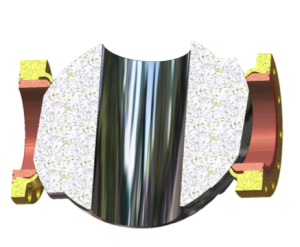
Fig. 7
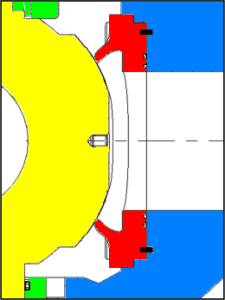
Fig. 8
In 2004, Aker Maritime pulled out and Bel Valves took control of the valve production, which resulted in another name change for the valve. From 2004, the valve was called the E Ball valve. "E" stands for eccentric and hence the name eccentric ball valve.
From 2004 to the present day, a large number of tests have been carried out on the valve design. Research has been carried out into the use of variable seat designs, the material qualities of the seats, and the coating techniques and qualities used on the hard coating applied to the valve's sealing surfaces. The seats now consist of the red spring section illustrated in Figure 8.
From 2003 to 2013, Bel Valves LTD delivered 202 E Ball valves to the Norwegian continental shelf. The valves have mainly been delivered to the Gullfaks, Oseberg and Snorre fields. The material grades the valves are manufactured in are either 22% chrome duplex, 25% chrome duplex, super austenitic stainless steel, 18% stainless steel or carbon steel. The valve is now NACE compliant and can also be supplied for acid service.
E Ball valves are mostly used in difficult applications or where you want a simple mechanical double sealing ball valve as an isolation valve.
Because the seats are fixed in the valve body, the valve is not dependent on floating seats that are affected by system pressure. Floating seats can easily be put out of action due to friction in the seat pocket or deposits settling behind the seats. The whole idea behind this valve solution was to create a robust double-sealing valve that was less dependent on maintenance, it should also be more resistant to opening at differential pressure and closing during flow. The concept of the valve is good but there were too many obstacles and it was too difficult to machine the valve within the required tolerances. In 2013, Bel Valves completed the development of the E-Ball valve.